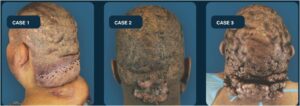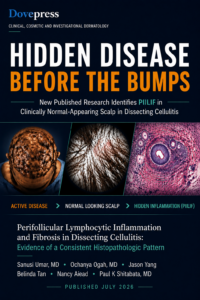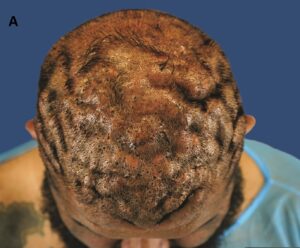

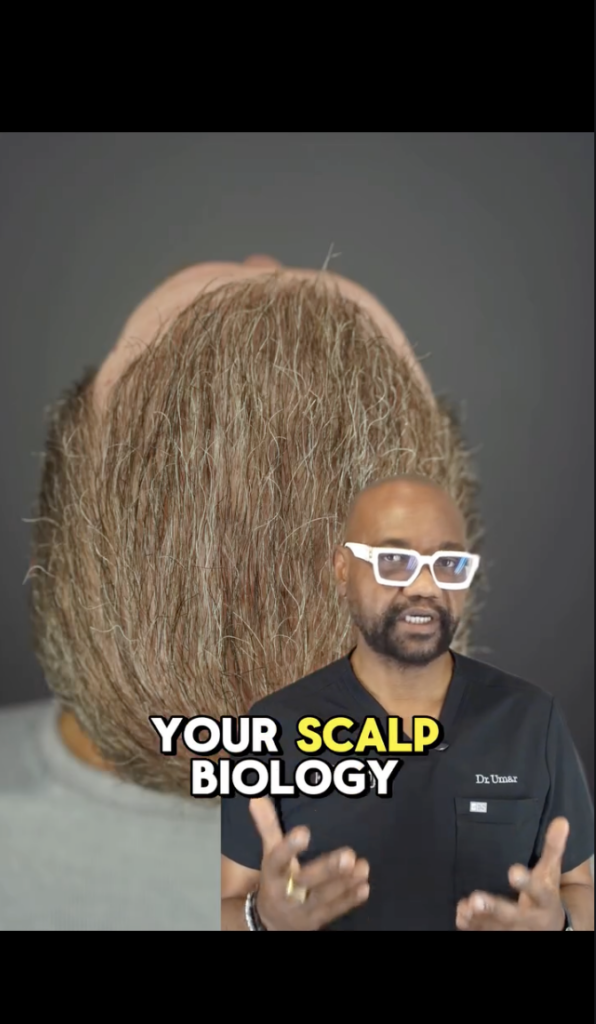
Severe hair loss can look like the final stage of androgenetic alopecia. In this short video, Dr. Sanusi Umar points to a study finding that raises a more complex question about inflammation, fibrosis, and the biology of the scalp.
“Severely bald?” That question opens Dr. Umar’s explanation. When male pattern baldness becomes advanced, the obvious assumption is that androgenetic alopecia, or AGA, has simply progressed further. The study discussed in the video suggests there may be another factor worth examining in some severe cases.
A Study Finding in Severe Male Pattern Baldness
Dr. Umar reports that PIILIF was more common in patients at Norwood level 5 or higher. He does not present that observation as proof that inflammation or fibrosis causes severe AGA. Instead, he frames it as a reason to ask whether those processes may be part of why some androgenetic hair loss becomes more severe.
The distinction matters. The short video is not arguing that every severe case has the same underlying biology. It is highlighting an association from the study and the clinical question that follows from it.
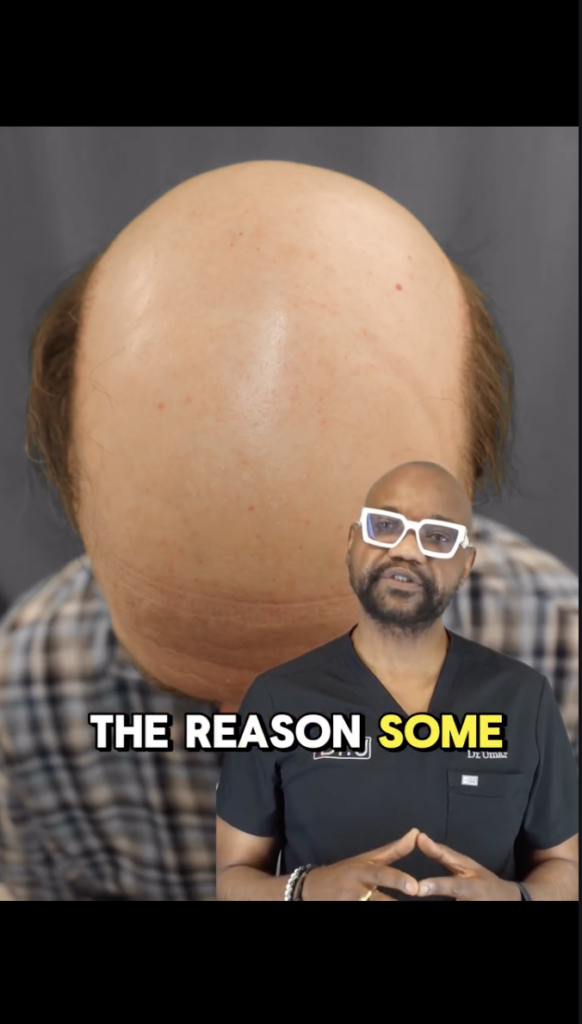
Look Beneath the Visible Bald Patch on Scalp
A visible bald patch on scalp may draw attention to the amount of hair that has been lost, but Dr. Umar’s message is to consider what may be happening beneath the surface. In the video, he specifically points to inflammation and fibrosis as possible contributors worth understanding in the context of severe AGA.
His practical takeaway is concise: “Understand your scalp biology.” The emphasis is on evaluation and on learning more about the condition before focusing only on additional growth.
Why Evaluation Comes Before Chasing More Growth
For someone thinking about more hair growth or repair hair transplant options, the video’s message is not to assume that severity tells the whole story. The supplied study finding raises a question about whether inflammation and fibrosis deserve attention in advanced cases, particularly at Norwood 5 and above.
This is an emerging research question, not a universal explanation for severe hair loss. As the accompanying caption stresses, evaluation matters and treatment should be individualized. The forward-looking point is simple: understanding scalp biology may help frame better questions before deciding what to pursue next.
Watch the Short Video
Watch on YouTube Shorts | Instagram | TikTok
Take the Next Step
Learn more: Restoring Hair With the uGraft Procedure
Free ConsultationMedical disclaimer: This article is for educational purposes only and is not medical advice. Evaluation matters, and treatment should be individualized. The study finding discussed here does not establish that inflammation or fibrosis explains every case of severe androgenetic hair loss.
Further Reading
- https://dru.com/piilif-in-dissecting-cellulitis-what-paired-biopsies-reveal-across-normal-appearing-scalp-quiet-nodules-and-active-lesionspiilif-in-dissecting-cellulitis/
- Umar Sanusi. Hair transplantation in patients with inadequate head donor supply using nonhead hair: report of 3 cases. Ann Plast Surg 2011; 67(4):322–5.
https://pubmed.ncbi.nlm.nih.gov/21540728/