


Dr. Sanusi Umar explains why donor boundaries should be based on the individual scalp, not only on a traditional diagram.
A hair transplant begins with a question that a standard map cannot fully answer: which areas of this particular scalp are appropriate for donor harvesting? In this short video, Dr. Sanusi Umar describes how the shave test and magnified scalp examination can help tailor that decision before graft targets are set.
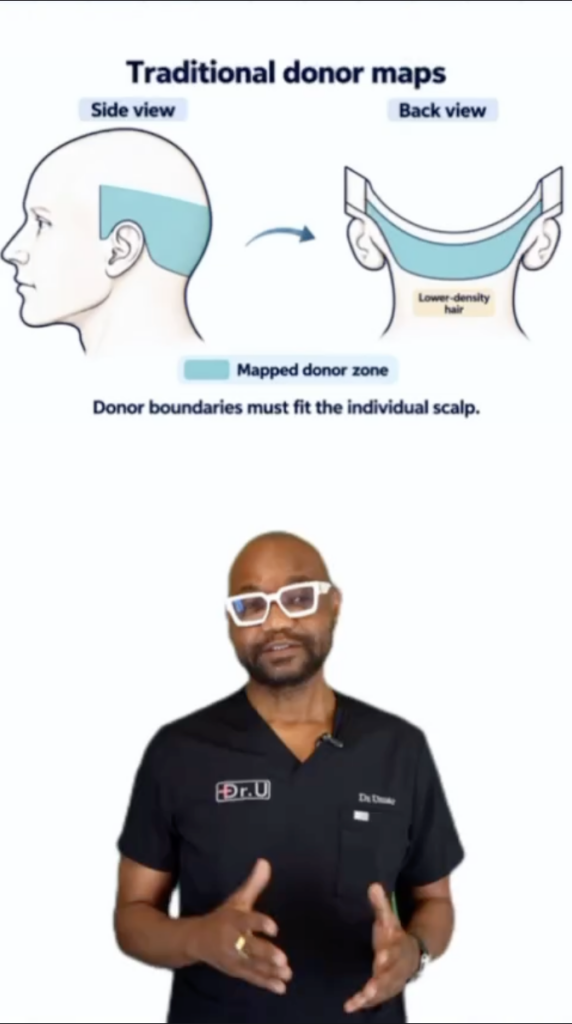
Why Traditional Hair Transplant Donor Maps Have Limits
Traditional donor maps use established anatomical boundaries, but patients do not all have the same hair density, shaft thickness, or pattern of thinning. Dr. Umar’s central point is that fixed borders can be too restrictive for one person and too broad for another.
As the video puts it, “fixed donor borders do not fit every patient.” The practical implication is not that every donor zone should be expanded. It is that the zone needs to be evaluated individually.
How the Shave Test Helps Refine Donor Boundaries
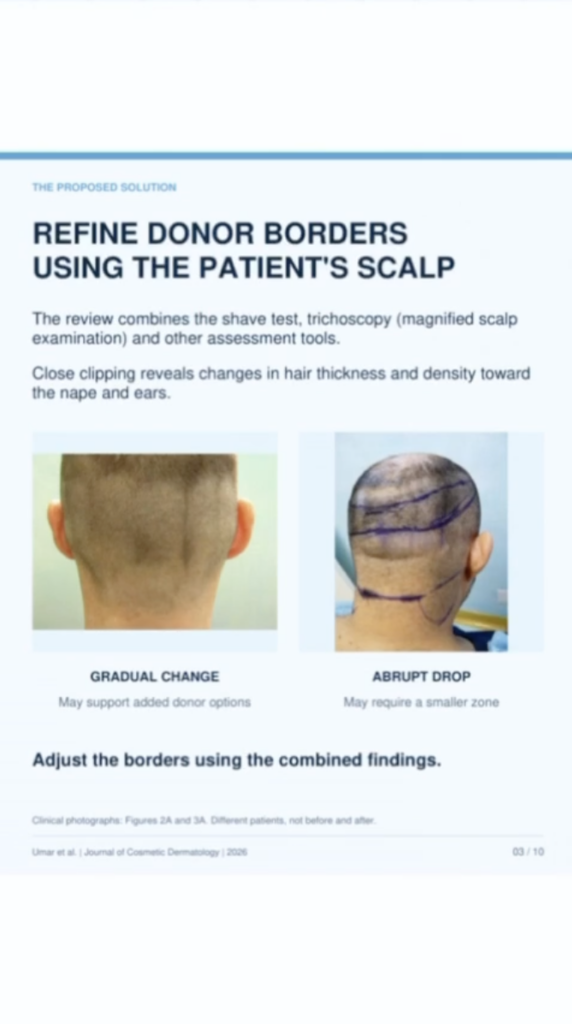
The assessment described by Dr. Umar combines close clipping, also called the shave test, with trichoscopy, or magnified scalp examination, and other clinical observations. Clipping makes changes in hair thickness and density near the nape and ears easier to assess.
A gradual transition may allow selected hairs beyond a conventional map to be considered. An abrupt decline in thickness or density, by contrast, may point toward a smaller donor region. Neither finding is a universal instruction to harvest more or less hair; each informs the individualized plan.
Donor Planning Before Graft Counts
The video also notes that finer donor hairs can help soften the edges of a transplanted hairline. The accompanying approved caption describes a 2015 clinical series of 128 men and a selected patient with a visible transplanted hairline at a 14-year follow-up, even as his original hairline receded. That example is an observation, not a promise that grafts will remain permanent in every patient.
The distinction matters for FUE technology and hair restoration planning alike. The available donor supply should be evaluated before deciding how many grafts to take, rather than allowing a target graft count to determine where harvesting occurs.
Dr. Umar’s closing advice is straightforward: “assess the patient before deciding how many grafts to take.” A donor plan tailored to the scalp may protect areas vulnerable to thinning while identifying suitable options where the findings support them.
Watch the Short Video
Take the Next Step
Ask for a donor-area assessment tailored to your scalp before setting hair transplant graft targets.
Free ConsultationMedical Disclaimer
This article is for general educational purposes and does not replace an individualized medical assessment. Donor suitability and transplant outcomes vary by patient; no particular result or long-term graft permanence is guaranteed.
Further Reading
- https://dru.com/hair-transplant-using-beard-hair-in-los-angeles/
- Umar Sanusi. Hair transplantation in patients with inadequate head donor supply using nonhead hair: report of 3 cases. Ann Plast Surg 2011; 67(4):322–5.
https://pubmed.ncbi.nlm.nih.gov/21540728/


