


A fixed donor-area map cannot tell the whole story. Dr. Sanusi Umar explains how a close-clipping assessment can help match hair transplant donor boundaries to each person’s actual hair pattern.
Two patients can have very different hair thinning patterns even when a traditional map marks the same general donor area. In this video, Dr. Sanusi Umar examines why those differences matter before harvesting hair and how the shave test can help identify a more individualized donor zone.
Why a Standard Hair Transplant Donor Map Can Fall Short
Traditional donor maps use fixed anatomical landmarks, but hair density and thickness do not follow identical boundaries in every person. Dr. Umar points to examples in which scars from follicular unit transplantation (FUT), planned using conventional donor mapping, extend outside the denser donor band. The concern is not the map alone, but whether the selected region truly reflects the patient’s own pattern.
What the Shave Test Shows
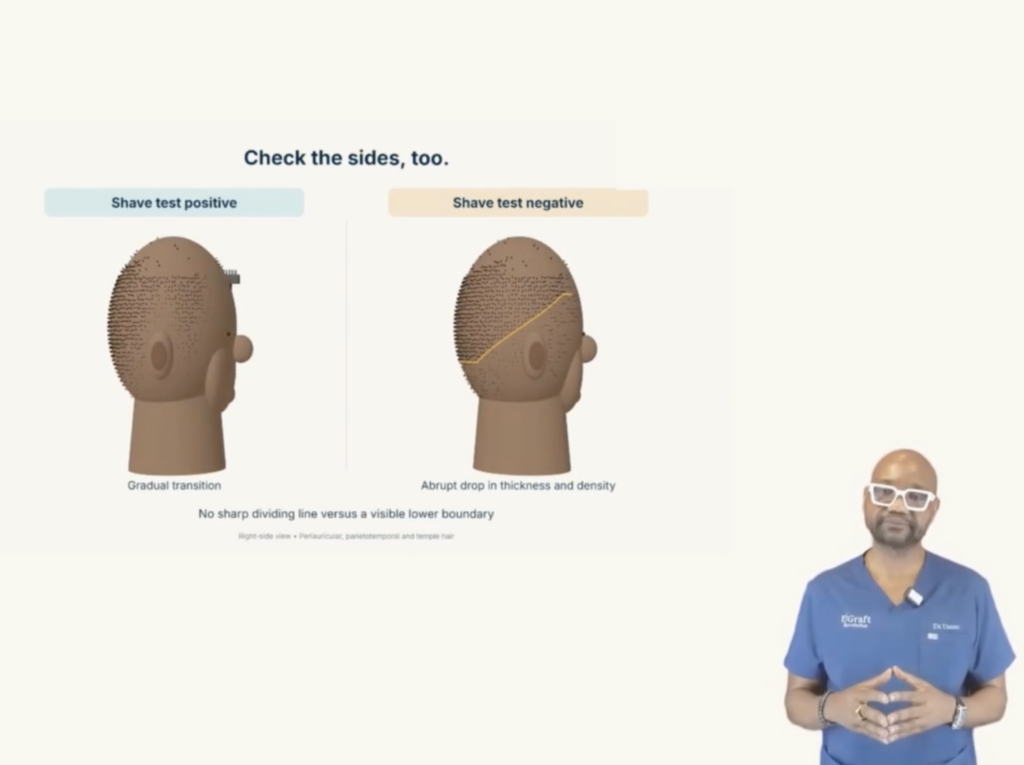
The shave test uses close clipping to make changes in hair thickness and density easier to assess. In Dr. Umar’s explanation, a positive shave test shows a gradual transition, while a negative shave test shows a sharper drop. The distinction applies not only to the back of the scalp and nape, but also to areas around the ears and temples.
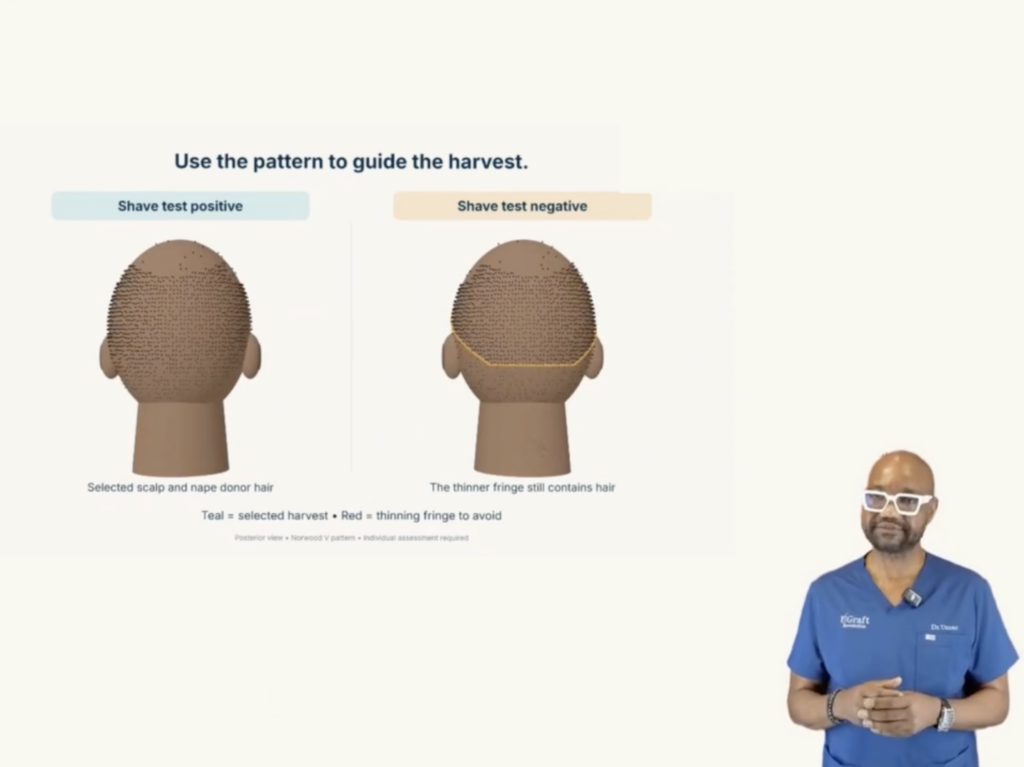
These patterns can influence the boundaries of the donor region. A positive result may support carefully selected harvesting from scalp, nape, temple, or around-ear hair. With a negative pattern, Dr. Umar advises remaining within the narrower qualified dense band rather than extending extraction into the thinning fringe.
Choosing Other Donor Sources When the Scalp Zone Is Limited
A smaller qualified scalp area does not mean the surgeon should simply push farther into less suitable scalp hair. Dr. Umar describes considering neck, beard, or body hair as additional sources when appropriate. In one case presented in the video, scalp extractions remained within a narrow donor band while neck and beard zones supplied additional hair, leaving disqualified scalp regions untouched.
What Follow-Up Findings Suggest, and What They Do Not Prove
Dr. Umar describes a 2015 series involving 128 men whose nape and around-ear hairs were selected after a positive shave test and implanted into the hairline, with conventional donor hair placed behind. He reports favorable hairline recession findings and high satisfaction at an average follow-up of 4.6 years.
He also describes a participant who returned 14 years later. In that patient, shave test-selected nape and around-ear hair used for the hairline and temples remained visible even as the original hairline had receded substantially. This individual observation supports the possibility of long-term survival in selected patients, but it is not a guarantee for everyone.
Dr. Umar makes the limitation explicit: the shave test does not guarantee lifelong donor-hair survival. Larger-scale studies are needed to validate these findings. The practical message is to use individual donor patterns to guide hair restoration decisions rather than assuming one fixed boundary suits every patient.
Watch the Short Video
Watch Dr. Umar explain the shave test, individualized donor boundaries, and the follow-up findings discussed in this video.
Take the Next Step
Learn more about Dr. U’s hair transplant donor services and individualized treatment planning.
Hair transplant services: https://dru.com/hair-surgery-dr-ugraft-hair-transplant-head-donor-services/
Free ConsultationMedical Disclaimer
This article is for educational purposes and does not replace an individualized medical evaluation. Donor suitability and transplant outcomes vary by patient; no test guarantees lifelong hair survival.
Further Reading
- https://dru.com/using-nape-hair-for-more-natural-looking-hairline-reconstruction-results/
- Umar Sanusi. Facial Surgery: Use of Nape and Peri-Auricular Hair by Follicular Unit Extraction to Create Soft Hairlines and Temples: My Experience With 128 Patients Aesthetic Surgery Journal Advance Access published September 22, 2015.
https://pubmed.ncbi.nlm.nih.gov/26399317/


