


Eleojo was losing hair, but an early explanation of traction alopecia did not feel adequate to her. In The Baldcast, she tells Dr. Sanusi Umar why she kept asking for a closer examination, and how a trichoscope eventually revealed signs of lichen Planopilaris (LPP), while a formal diagnosis remained pending.
“I Want to Keep It”
When Eleojo first sought medical advice, she recalls being told that she had plenty of hair. That observation missed what mattered to her: the hair she was losing. “But I’m losing hair. I want to keep it,” she said. Her concern was not simply how her hair looked at that moment. She wanted the change she had noticed to be taken seriously.
In her conversation with Dr. Umar, Eleojo explains that she tried to remain respectful while pushing back against being dismissed. She felt something more was happening than an ordinary concern about appearance. Dr. Umar acknowledged that the issue was more than vanity.
When Hair Type Became an Assumption
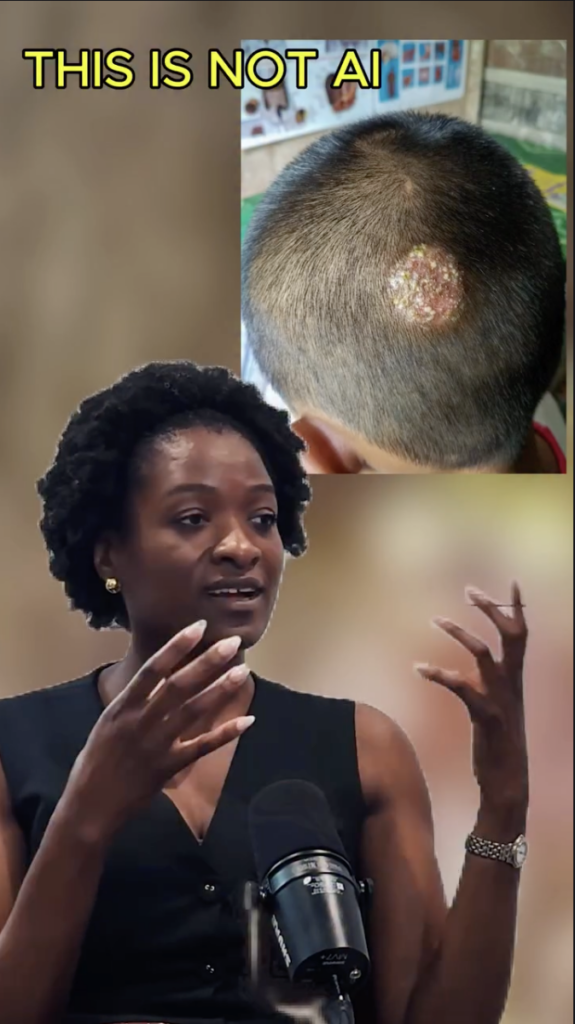
Eleojo says traction alopecia was suggested because of her hair type. She also recalls a possible fungal explanation being raised because she worked with children. These were possibilities presented to her, not confirmed diagnoses in this chapter.
What troubled her was the distance between those explanations and her own experience. She could see that she was losing hair and wanted someone to investigate rather than rely on an assumption. Her account shows why the question of what is causing hair loss matters to the person experiencing it, even when their hair still appears plentiful to someone else.
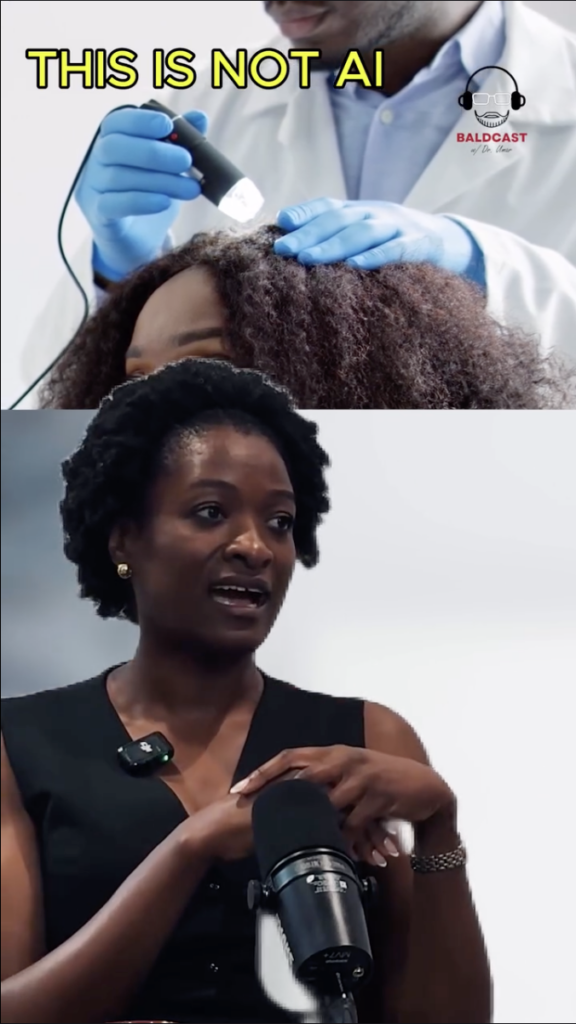
A Closer Look With a Trichoscope
Eleojo describes Dr. Wilson as the first clinician to examine her hair and scalp with a trichoscope. During that examination, she says, they saw signs of LPP, or lichen Planopilaris, a condition discussed here in the context of scarring hair loss. That finding changed the direction of the conversation, but it was not yet a formal biopsy-confirmed diagnosis.
When Dr. Umar asks what happened next, Eleojo explains that she was still waiting for a biopsy. She had tried minoxidil but reacted to it and could not continue. She later saw a dermatologist in the United Kingdom and began doxycycline. Asked whether she had received a biopsy by then, she says no: she was still waiting.
The Question Still Open
For Eleojo, the trichoscope examination provided a meaningful clue after earlier assumptions about traction alopecia and a fungal condition. Yet the chapter ends before the biopsy she was awaiting. The distinction matters: signs seen during an examination are part of her account, not a confirmed final diagnosis in this excerpt.
Her conversation with Dr. Umar leaves viewers with the central question of this chapter: what happens when someone reporting hair loss is given a closer look? The next part of her story remains to be told.
Watch the Chapter
The Baldcast, Episode 7, Chapter 05.
Take the Next Step
Follow The Baldcast for the next chapter.
Free Consultationhttps://dru.com/hair-surgery-hair-loss-medication-services/
Medical Disclaimer
This article recounts one person’s experience and is for informational purposes only. It is not a diagnosis or a substitute for individualized medical advice.
Further Reading
- https://dru.com/lichen-planopilaris-eleojo-hair-loss-signs/
- Umar S, Kan P, Carter MJ, Shitabata P, Novosilska M. Lichen Planopilaris Responsive to a Novel Phytoactive Botanical Treatment: A Case Series. Dermatol Ther (Heidelb). 2022 Jul;12(7):1697-1710. doi: 10.1007/s13555-022-00749-3. Epub 2022 Jun 8. PMID: 35674981; PMCID: PMC9276860.
https://pmc.ncbi.nlm.nih.gov/articles/PMC9276860/


