


During Juan’s scalp examination, Dr. Sanusi Umar explains why the visible growth is only one part of the treatment discussion. Juan’s account of recent changes and a moment of vulnerability make the conversation both clinical and personal.
Juan tells Dr. Sanusi Umar that the affected area has been producing more discharge lately. As Dr. Umar examines his scalp, Juan also describes a change in the direction of the growth. Their exchange raises a central question about acne keloidalis nuchae (AKN): what does it mean to treat the condition rather than focus only on what is most visible?
Juan Describes Recent Changes
Dr. Umar asks whether Juan has been experiencing discharge. Juan confirms that he has and says it seems to be happening more frequently. During the examination, Dr. Umar applies pressure and describes seeing a small amount of fluid. The discussion stays focused on what Juan is experiencing and what Dr. Umar observes in that moment.
Juan then explains that the affected area seems to have extended farther toward one side. Dr. Umar describes it as becoming “lopsided,” and Juan agrees. These observations help frame the treatment conversation without establishing a surgical outcome or predicting what will happen next.
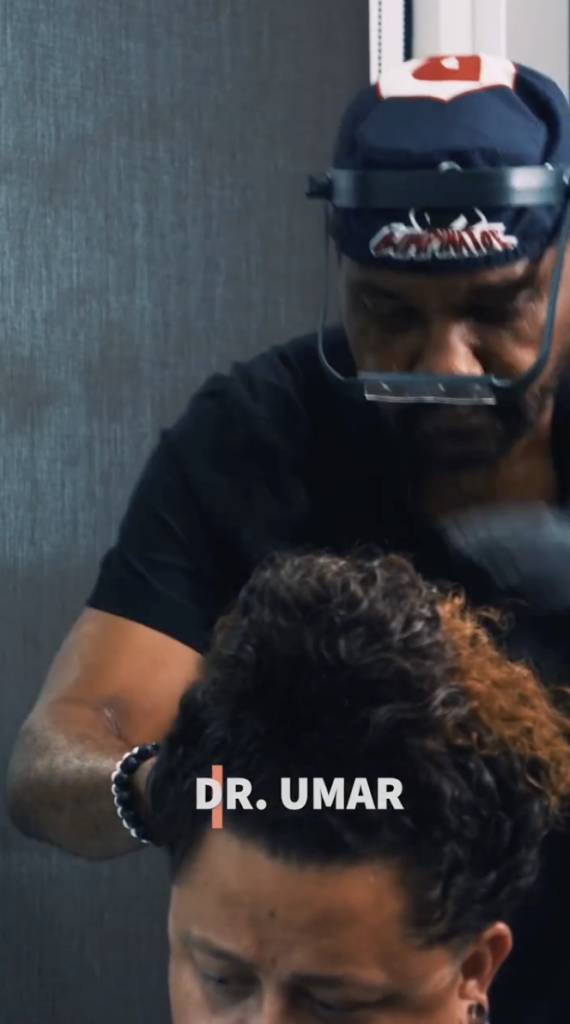
The Iceberg Comparison in Acne Keloidalis Nuchae
Dr. Umar makes an important distinction: treatment is not just about removing the visible AKN growth. He compares that removal to taking an iceberg out of the water. In his explanation, the surrounding “sea” also matters because it represents the conditions associated with the iceberg forming.
He identifies that sea as the rest of Juan’s scalp and says it must be addressed as part of the treatment plan. The analogy is a way of explaining the broader scope of the examination, not a promise that a particular treatment will prevent recurrence. For people searching for how to treat bumps on the back of the head, this conversation illustrates why an individual assessment may look beyond the most obvious area.
Feeling Exposed During the Examination
The conversation turns personal when Juan asks whether he can put his hair down. Dr. Umar agrees. Juan then says, “I feel exposed.” It is a brief but meaningful moment: allowing the affected area to be examined also means showing something Juan would prefer to keep covered.

Juan’s words give the examination an emotional dimension without requiring assumptions about how he feels beyond what he says. The video does not show a completed treatment or a final result. It shows an assessment, an explanation, and a patient voicing discomfort with the visibility of his condition.
Looking Beyond the Visible Bump
Juan’s visit underscores the difference between discussing a visible growth and developing a plan for the broader scalp. Dr. Umar’s iceberg comparison keeps the focus on evaluating the surrounding area, while Juan’s comments show why the experience of examination matters to the person receiving care. Questions about bumps that keep coming back require individualized medical assessment rather than a conclusion drawn from a short video.
Watch the Short Video
Watch Juan’s examination on YouTube
Take the Next Step
Learn more about AKN bumps on the back of the head and neck
Free ConsultationMedical Disclaimer
This article is for educational purposes only and does not provide a diagnosis or individualized treatment advice. Treatment decisions require an evaluation by a qualified medical professional. The video does not establish Juan’s eventual treatment outcome.
Further Reading
- https://dru.com/juan-acne-keloidalis-nuchae-daily-habits/
- Umar, S., & Sila, C. R. (2021). Acne keloidalis nuchae: A role for low-dose radiotherapy. JAAD Case Reports, 13, 90–93. https://doi.org/10.1016/j.jdcr.2021.05.008


