


When James returned to see Dr. Sanusi Umar, he already had a large lump on the back of his head. What made his acne keloidalis nuchae case especially revealing was that Dr. Umar had seen him years earlier, giving them a record of how much the condition had changed over time.
James reminded Dr. Umar of that earlier visit: “Doctor, don’t you remember me? I saw you a few years ago.” That prompted a review of his medical record, where earlier photographs showed nodules on the back of his head. Dr. Umar noted that those earlier findings were “nothing close to what he has” at the later visit.
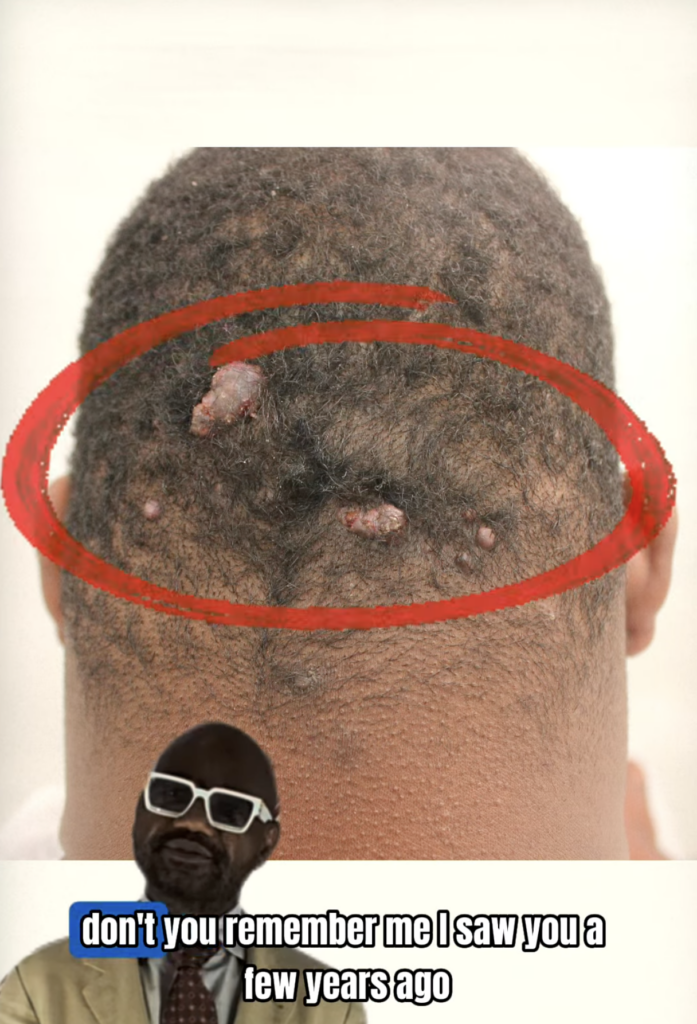
What Changed Since James’s Earlier Visit
The earlier photographs gave Dr. Umar an important point of comparison. At that time, James had some nodules on the back of his head, but Dr. Umar said he did not have the involvement on top of his head that was present later. For someone dealing with bumps that keep coming back, that kind of documented change can make the progression easier to recognize.
Dr. Umar also recalled that he had advised James to have the affected area taken out during the earlier period. James did not move forward with that recommendation then. Years later, the contrast between the old photographs and his current condition became central to the discussion.
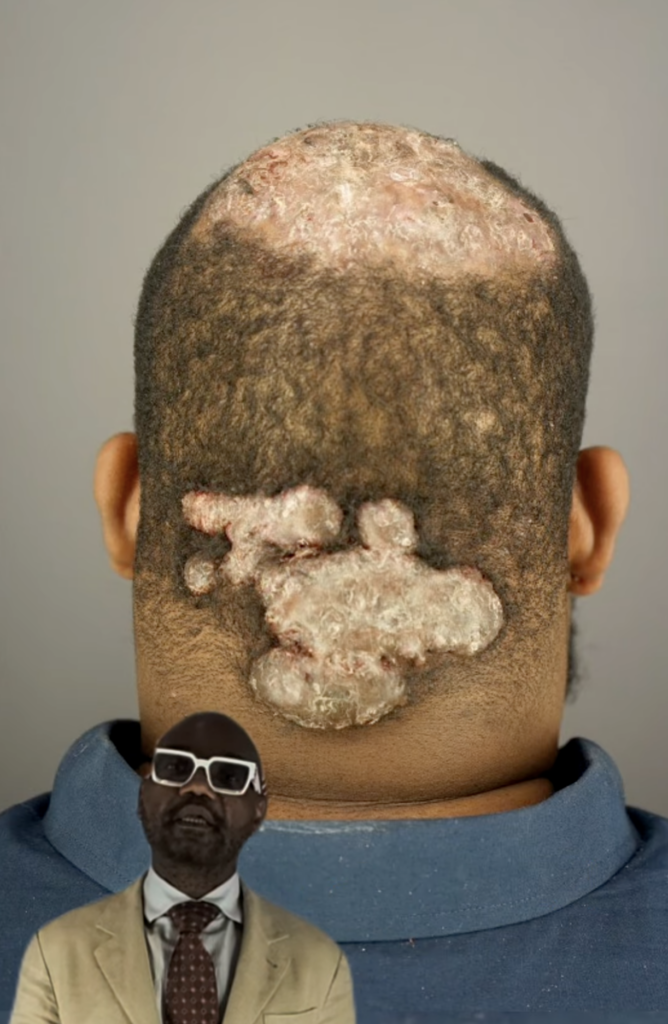
Why Dr. Umar Emphasized Acting on AKN
Looking at the earlier and later images together, Dr. Umar drew a direct lesson from James’s case. “If anything, it just speaks to how important it is to act in these conditions,” he said. The chapter does not present a later treatment outcome. Instead, it focuses on the change documented across the years and the importance Dr. Umar places on addressing the condition.
The supplied material also frames AKN as more than isolated bumps on the back of the head, describing pain, itching, infections, raised scars, and permanent hair loss as concerns associated with the condition. James’s case provides the human example at the center of that message: what was once a smaller area of visible nodules had become substantially different by the time he returned.
James’s Case as a Warning Against Waiting
Dr. Umar closes the chapter by calling James’s case “a testament.” The comparison preserved in his medical record allows viewers to see why the earlier recommendation mattered and why Dr. Umar stresses timely attention when a scalp condition is changing.
This chapter stops at that point in James’s story. What happens next depends on his individual evaluation and treatment plan, but the message from this stage is clear: a condition that is changing should not simply be assumed to be normal or left unaddressed.
Watch the Chapter
Watch James’s Bumpinator chapter on YouTube.
Also available on Instagram and TikTok.
Take the Next Step
Free Consultationhttps://dru.com/akn-treatment/
Medical disclaimer: This article describes one patient’s experience and the information presented in this chapter. Individual conditions, treatment decisions, and outcomes vary. This information is educational and is not a substitute for individualized medical evaluation or advice.
Further Reading
- https://dru.com/non-surgical-medical-treatment-services-in-los-angeles/
- Umar, Sanusi et al. “A Retrospective Cohort Study and Clinical Classification System of Acne Keloidalis Nuchae.” The Journal of clinical and aesthetic dermatology vol. 14,4 (2021): E61-E67.
https://www.ncbi.nlm.nih.gov/pmc/articles/PMC8142833/


