


Research led by Dr. Sanusi Umar raises an important question about acne keloidalis nuchae: could changes beyond the visible bumps help explain why some patients develop deep scalp folds associated with CVG? The findings point to PIILIF in clinically normal-looking scalp and reinforce the importance of examining the whole scalp.
Could new scalp folds be a warning sign? In the video, Dr. Umar revisits research that connected acne keloidalis nuchae (AKN) with cutis verticis gyrata (CVG), the deep scalp folds described in the study. The sequence he describes is notable: nape AKN came first, and CVG folds followed within about two years alongside widespread scalp AKN.
Acne Keloidalis Nuchae and the Appearance of CVG
Dr. Umar explains that in a 2022 study, his team identified CVG in three of 108 patients studied. In those cases, the AKN at the nape preceded the scalp folding, while widespread scalp AKN appeared alongside the later CVG folds.
The finding does not mean every case of AKN will progress to scalp folding. The approved caption makes that limitation explicit, while noting that new folds, spreading lesions, or drainage deserve a full-scalp assessment.
PIILIF in Scalp That Looked Normal
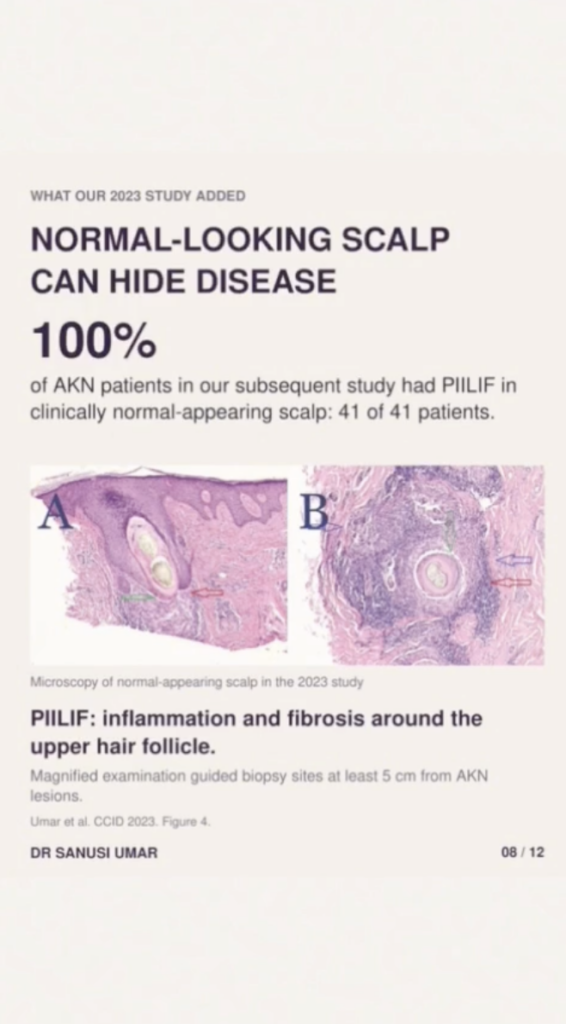
A subsequent study added another piece to the picture. Dr. Umar states that PIILIF was found in clinically normal-looking scalp in 100% of the AKN patients studied. The video describes PIILIF as an inflammatory and fibrotic state, while the accompanying research graphic defines it as inflammation and fibrosis around the upper hair follicle.
“PIILIF may be a common link,” Dr. Umar says. In the video, he presents the finding as a possible connection between AKN and CVG scalp folding, not as a certainty. The approved caption likewise says the later studies identified PIILIF even in scalp that looked normal.
Why Whole-Scalp Assessment Matters
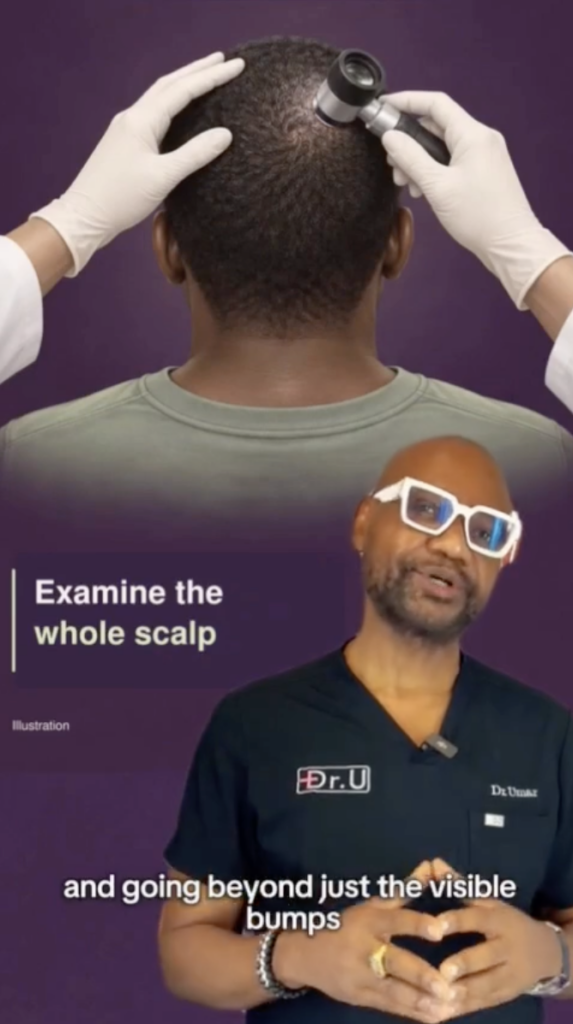
The practical message is to look beyond what is most obvious. Dr. Umar says the finding highlights the importance of examining the whole scalp and “going beyond just the visible bumps.” That is especially relevant when new scalp folds, spreading lesions, or drainage are present.
The research raises a focused clinical question: whether PIILIF may help connect AKN with scalp folding in CVG. The video does not claim that every patient follows this course. Instead, it uses the research to show why apparently normal scalp can still deserve attention when evaluating the broader pattern of disease.
Watch the Short Video
Take the Next Step
Learn more about AKN treatment
Free ConsultationMedical Disclaimer
This content is for educational purposes only and is not a substitute for individualized medical advice, diagnosis, or treatment. A qualified medical professional should evaluate new scalp folds, spreading lesions, drainage, or other scalp concerns in the context of the individual patient.
Further Reading
- https://dru.com/folliculitis-keloidalis-nuchae-life-before-after/
- Umar S, Ogah O, Yang J, Tan BH, Aiead N, Shitabata PK. A Candidate Syndromic Triad of Acne Keloidalis Nuchae, Dissecting Cellulitis, and Secondary Cutis Verticis Gyrata. Clin Cosmet Investig Dermatol. 2026 Aug 28;19:615576. doi: 10.2147/CCID.S615576. PMID: 42683347; PMCID: PMC13532648.
https://www.dovepress.com/a-candidate-syndromic-triad-of-acne-keloidalis-nuchae-dissecting-cellu-peer-reviewed-fulltext-article-CCID


