


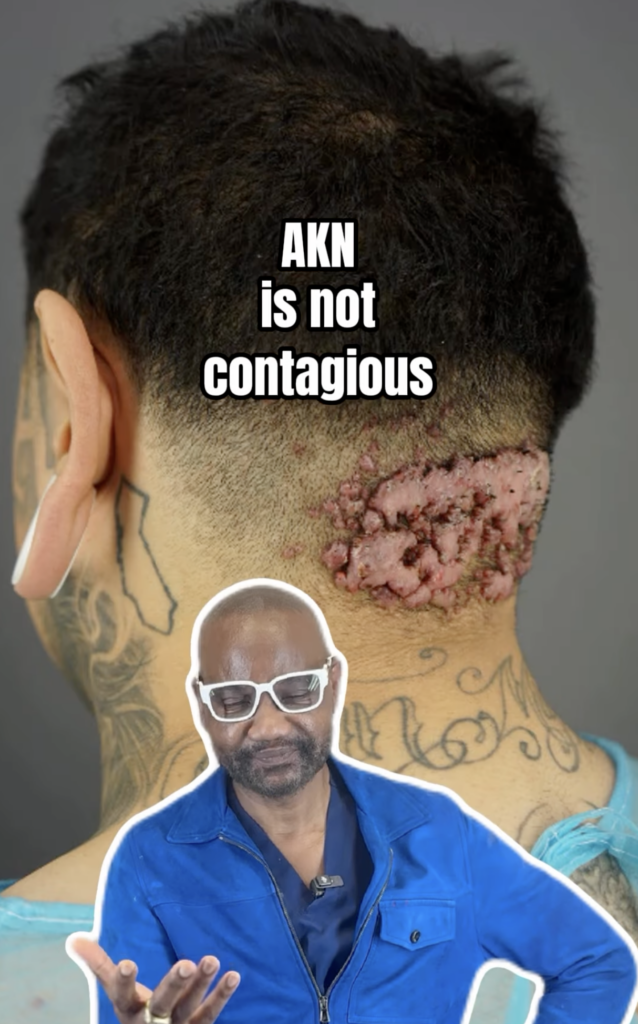
For this patient, the visible effects of AKN affected more than the back of the head. Fear of questions and unwanted attention eventually made being seen in public difficult.
“AKN is not contagious,” Dr. Sanusi Umar states at the opening of this short video. He also describes acne keloidalis nuchae as an autoimmune inflammatory condition that is not infectious. That distinction matters in this patient’s story because the visible condition became a source of stigma, questions, and increasing isolation.
When Acne Keloidalis Nuchae Becomes Socially Isolating
The patient describes worrying about how other people would react, including at his children’s school. He anticipated that people would ask questions or point out the condition. As it worsened, those concerns changed how willing he was to be around others.
“I got worse to a point where I didn’t wanna be seen in public anymore,” he says. “Like, I’m trapped.”
No Shame and No Unnecessary Avoidance
Dr. Umar connects misinformation about the condition with the possibility of stigma and unnecessary avoidance. The approved caption reinforces the same message in direct terms: “AKN isn’t contagious. It isn’t infectious. No shame. No isolation.”
For this patient, the concern was not abstract. He describes using another mask so that other people would be less likely to ask about what they saw. His comments show how bumps on the back of the head and other highly visible changes can affect everyday interactions when people misunderstand what they are seeing.
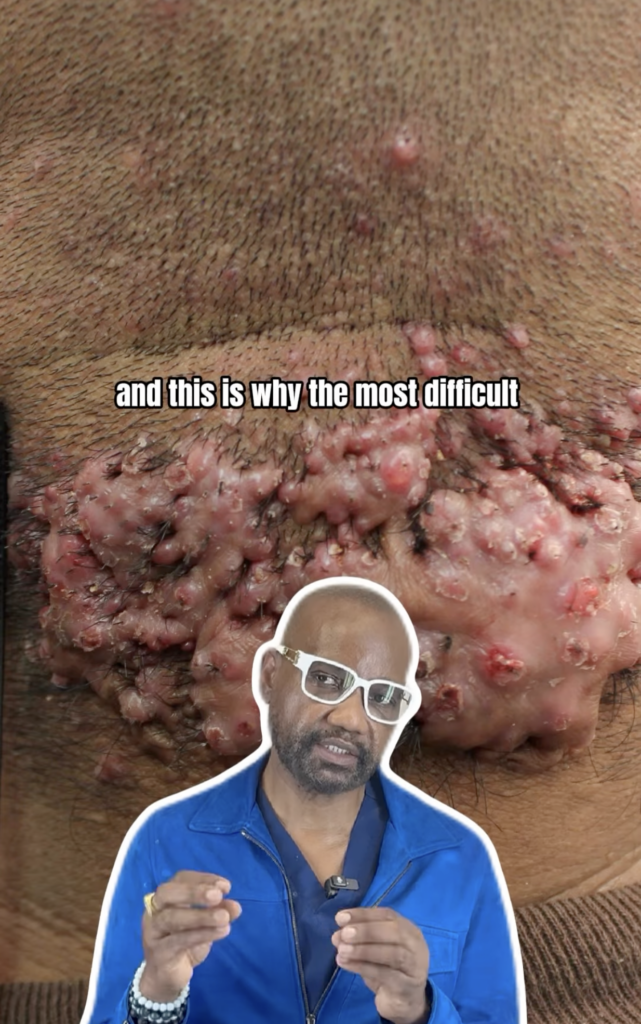
Specialized Care for Difficult AKN Cases
Dr. Umar closes by describing the goals of his approach in broader terms. “We’re not just removing disease. We are restoring confidence,” he says. He also speaks about preventing recurrence and pursuing an outcome that looks and feels natural.
The short video does not present a final result for this patient. Instead, it establishes why the case matters: a visible condition, the social burden described by the patient, and Dr. Umar’s emphasis on specialized care for challenging cases. For people searching for information about acne keloidalis nuchae, bumps on the back of the head, or burning hairline bumps, the central message here is clear: this patient’s condition should not be treated as a reason for shame or isolation.
Watch the Short Video
Watch the full short on YouTube Shorts
Also available on Instagram Reels
Take the Next Step
Learn more about AKN treatment on DrU.com
If you have persistent scalp or hairline bumps, seek an individualized evaluation from a qualified medical professional.
Medical disclaimer: This article describes one patient’s experience and is provided for educational purposes only. It is not medical advice. Individual circumstances and results vary.
Further Reading
- https://dru.com/scalp-keloids-affect-dreams-caree/
- Umar S, Khanna R. Papular acne keloidalis nuchae treatment success using follicular unit excision. JAAD Case Rep. 2023 Jul 25;39:96-100. doi: 10.1016/j.jdcr.2023.07.013. PMID: 37621307; PMCID: PMC10445098.
https://pmc.ncbi.nlm.nih.gov/articles/PMC10904000/


