


By Sanusi Umar MD | Board-certified dermatologist and hair surgeon
A closer look at the donor scalp may reveal additional graft options in some patients and areas best avoided in others.
On October 16, 2026, Dr. Umar and colleagues published a review in the Journal of Cosmetic Dermatology examining how donor boundaries can be tailored to each patient. The paper connects the shave test, first described by Umar in 2015, with other evidence supporting individualized donor assessment. The authors are Sanusi Umar, Aditya K. Gupta, Vasiliki Economopoulos and Mesbah Talukder. Read the open-access review or visit the publisher page. [1]
A hair transplant begins with deciding where the grafts should come from. The safe donor area, or SDA, is the part of the scalp considered more likely to retain hair as pattern hair loss progresses. Its boundaries help guide which follicles may be suitable for transplantation. Follicular unit excision (FUE) removes these follicular units individually.
Dr. Umar’s FUE shave test examines the patient’s actual pattern of donor hair thickness and density after close clipping. It can help refine those boundaries, particularly near the nape and around the ears. A favorable pattern may support considering additional donor hair. An unfavorable pattern may indicate that the harvesting area should be smaller. [1,2]
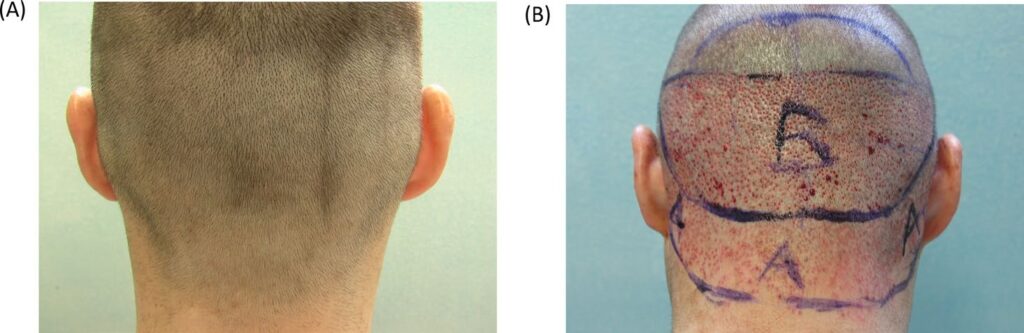
Figure 1. A favorable shave-test pattern in a selected patient. (A) Clipped scalp shows a gradual transition in hair thickness and density toward the nape. (B) The same patient immediately after FUE, with selected central and peripheral donor regions included.
How the FUE shave test works
In the published technique, the back and sides of the head and the nape and periauricular regions are clipped close enough to reveal the transition in hair thickness and density. Periauricular means around the ears. Together, the nape and periauricular regions are often abbreviated NPA. [2]
The clinician looks for a smooth transition or a sudden step down into finer, sparser hair. Magnified scalp examination, called trichoscopy, can add information about follicle density and variation in hair thickness. The findings are interpreted alongside age, family history and the pattern and speed of hair loss. [1]
What a positive pattern means
A smooth, gradual transition without a sharp dividing line is described as shave-test positive. In carefully selected patients, it may support considering a limited peripheral donor zone, including finer hair for the leading edge of a hairline or the temples. A positive pattern is one part of the assessment, rather than a guarantee about future hair loss. [1]
What a negative pattern means
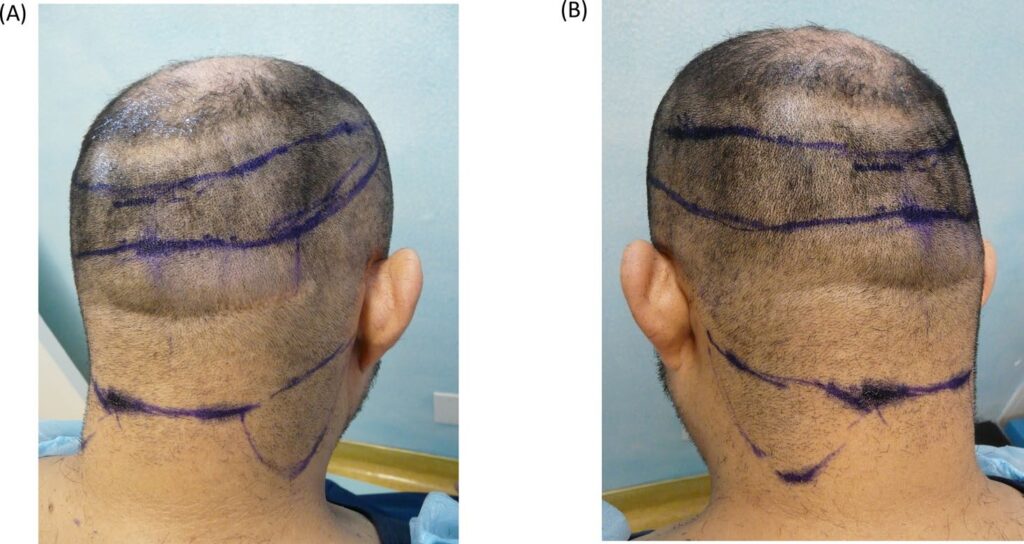
An abrupt decline in hair thickness or density, sometimes with a clearly visible lower fringe, is described as shave-test negative. It can reveal retrograde thinning, which affects the donor fringe from below. Hair in the affected region is generally avoided for scalp donor harvesting. [1,2]
Why donor boundaries need individual assessment
Traditional donor maps provide useful conservative starting points. However, patients differ in the height of their remaining fringe, the extent of donor thinning and their likely progression. Thinning may extend into a region that a standard diagram would otherwise include. Other patients may have suitable hair beyond a conventional boundary. [1]
The 2026 review proposes first identifying a conservative core donor zone, then refining its borders using the scalp findings. Optional peripheral regions are considered only after that assessment. The extent of baldness on top and thinning at the lower donor fringe are related planning issues, but one does not define the other. [1]
Thinning can extend into a previously used donor zone
A separately assessed alternative source
If nape hair is unsuitable
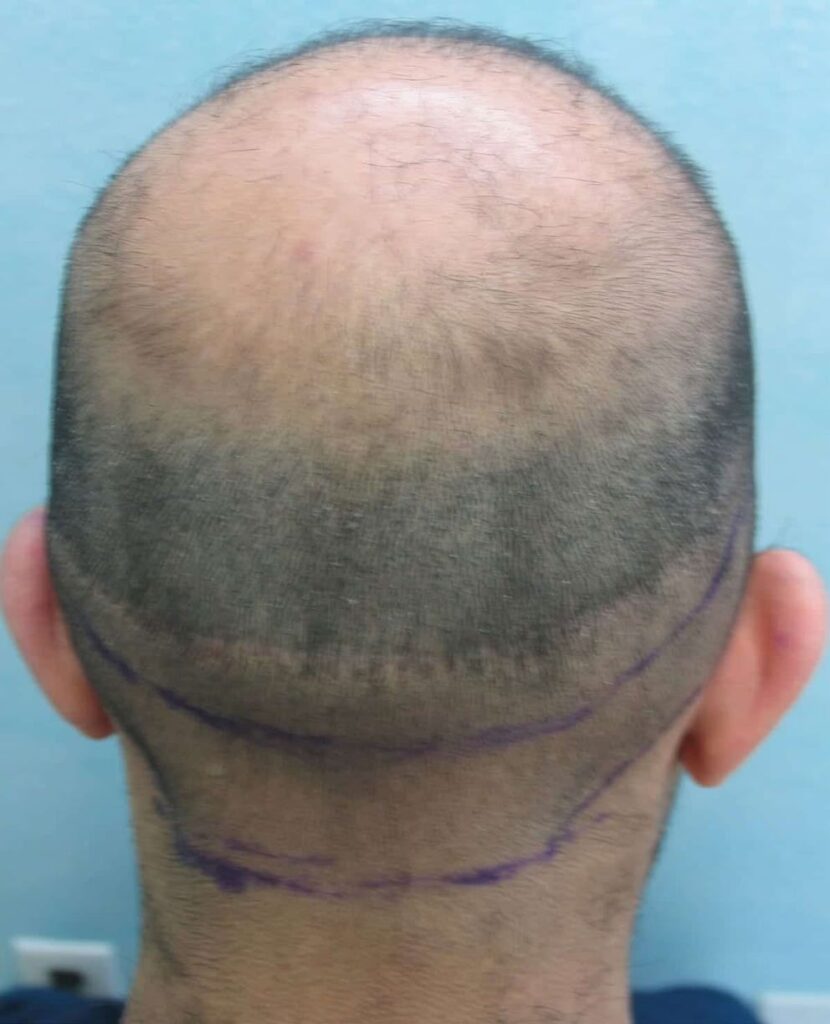
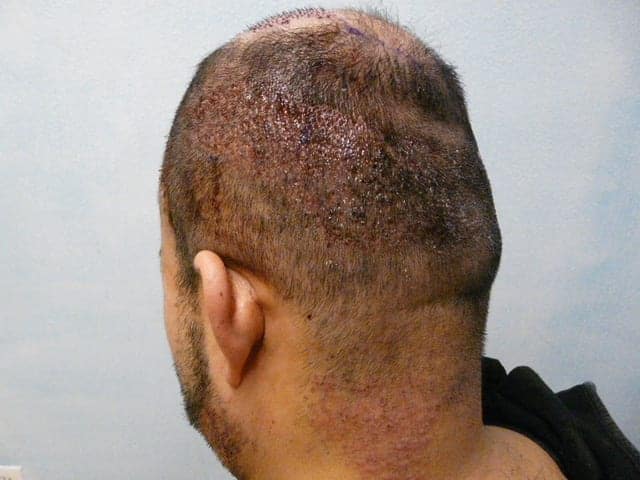
An unfavorable NPA assessment does not automatically rule out hair transplantation. Suitable conventional scalp hair may still be available. Depending on the patient and the purpose of the grafts, separately assessed beard, neck or other body hair may offer alternatives. Hair characteristics and the appearance of each donor site remain part of the decision. [1,2]
How finer donor hair can soften a hairline
A natural hairline usually has a softer transition at its leading edge. In selected patients, finer NPA hairs can be useful for this detail, while other scalp grafts provide hair behind it. The suitability of a graft depends on its characteristics and the area being restored, as well as the donor assessment. [1,2]
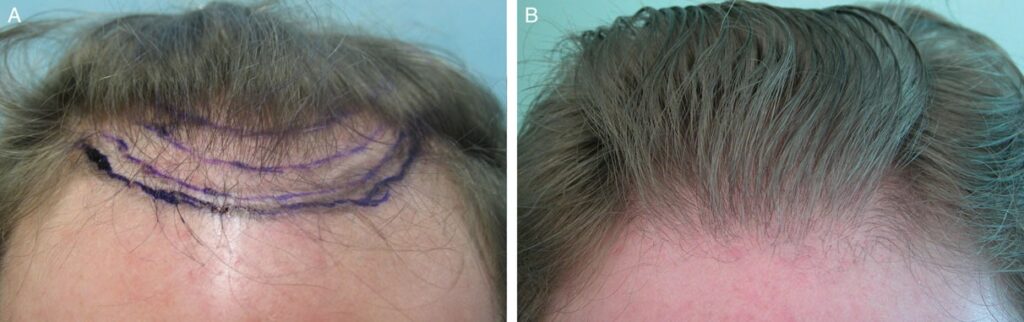
Figure 5. A hairline example from the 2015 series. (A) Before surgery. (B) Two years after a 1,000-graft procedure using predominantly nape and periauricular hair. The aim was a softer transition at the front of the hairline.
What the published studies report
Umar’s 2015 observational series described 128 men treated with NPA hair for hairline and temple restoration after shave-test selection. Follow-up was collected through patient questionnaires. [2]
| Questionnaire | Respondents | Average time after surgery |
| First | 91 of 128 | 25.5 months |
| Second | 33 | 4.6 years |
Patients reported high average satisfaction, but some reported graft loss. The longer follow-up was available from only a subset of patients and relied on their recollection. These results support selective use of NPA hair; they do not establish a precise prediction of lifetime graft survival. [1,2]
The 2026 paper is a narrative review of existing research and clinical examples. It brings the shave test together with donor grading, ratio-based assessment and trichoscopy, and calls for larger prospective studies with standardized long-term follow-up. [1]
An individual result 14 years after FUE
The new review includes photographs of the same patient whose favorable donor transition is shown in Figure 1 above. At 14 years after FUE, the transplanted hairline, including NPA grafts, appeared preserved despite further recession of native frontal hair. The nape donor region was also shown at follow-up. [1]
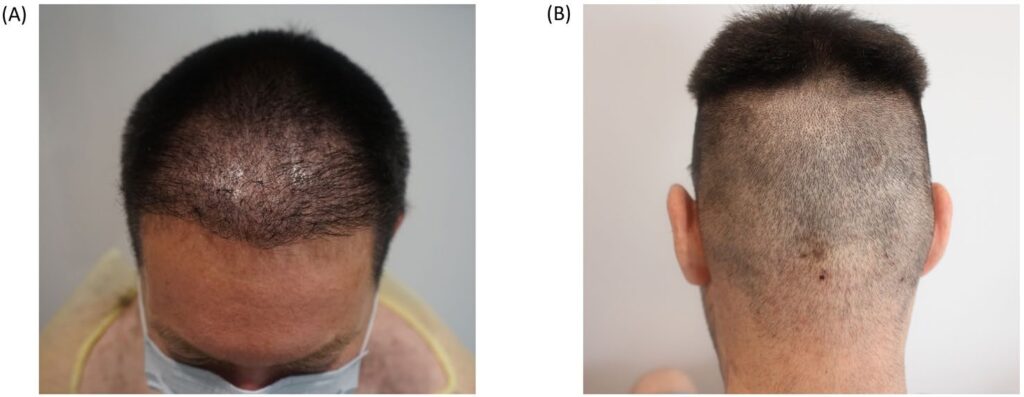
These photographs illustrate durability in a selected patient. They are separate from the questionnaire follow-up in the 2015 series and do not represent a 14-year follow-up of all 128 participants. [1]
Can individualized assessment increase the donor supply?
It may identify additional scalp donor options in suitable patients. That can matter when finer hair is needed for a hairline or when donor supply is limited. In other patients, the same assessment may show why an assumed donor zone should be reduced. [1]
The number of usable grafts depends on the area judged suitable, baseline hair density, hair thickness, prior harvesting and how much donor coverage should remain. The review does not establish a standard number of additional grafts or a universal lifetime graft allowance. A favorable shave test alone does not determine how large a session should be. [1]
Planning for future hair loss
Younger patients and those with rapid progression, early-onset loss or a strong family history of extensive baldness need especially conservative planning. A favorable result today cannot determine the eventual pattern of baldness. Reassessment, discussion of medical treatment and staged surgery may be appropriate parts of a long-term plan. [1]
Frequently asked questions
Does a positive shave test mean the donor hair is permanent?
No test can guarantee lifelong permanence. A favorable transition may support selected use of additional donor hair, but the decision also depends on trichoscopy, history and other signs of donor stability. [1]
Can the donor assessment change later in life?
Yes. Donor hair characteristics and the extent of thinning can change over time. This is one reason reassessment before further harvesting matters, even after a previous favorable examination. [1]
Does the published evidence apply equally to women?
The original 128-patient series involved men. Its findings should not automatically be generalized to women. Donor suitability in a woman requires assessment of her diagnosis and the distribution of thinning, rather than assuming that an SDA is always present or always absent. [1,2]
Does donor assessment matter for strip surgery too?
Yes. Donor stability matters with both FUE and strip harvesting. FUE removes individual follicular units across a field, whereas strip surgery removes a strip of hair-bearing scalp. Neither harvesting method makes an unsuitable donor region suitable. [1]
Does the technique require close clipping?
The published shave test uses close clipping of the donor regions being examined so the transition is visible. The extent of clipping and how it fits into the assessment or procedure should be discussed during consultation. [2]
Discussing your donor options
At Dr. U Hair and Skin Clinic in Manhattan Beach, donor planning considers the available scalp hair, the purpose of the grafts and the likelihood of future hair loss. You can begin with the online hair consultation form and photographs. Photographs can start the discussion; the final donor plan requires an appropriate clinical assessment.
Free Consultation
References and further reading
[1] Umar S, Gupta AK, Economopoulos V, Talukder M. Redefining the Safe Donor Area in Follicular Unit Excision: Toward Dynamic, Patient-Specific Zones. Journal of Cosmetic Dermatology. 2026;25:e71250. doi:10.1111/jocd.71250. Full text | Publisher.
[2] Umar S. Use of Nape and Peri-Auricular Hair by Follicular Unit Extraction to Create Soft Hairlines and Temples: My Experience With 128 Patients. Aesthetic Surgery Journal. 2015;35(8):903-909. doi:10.1093/asj/sjv137. PubMed record.
Related clinic examples: Restoring a receding hairline with nape and scalp hair; Nape hair used to soften a pronounced widow’s peak.