


Retrograde alopecia is often associated with pattern hair loss. In this short video, Dr. Sanusi Umar explains why that visible pattern may not tell the whole story and why PIILIF may be relevant in some patients.
“Think retrograde alopecia is just advanced pattern hair loss?” Dr. Umar opens with that question, then answers: “Well, not always.” In his published pattern hair loss study, he says researchers found PIILIF, described in the video as hidden inflammation and early scarring around the follicles, even when the scalp looked normal.
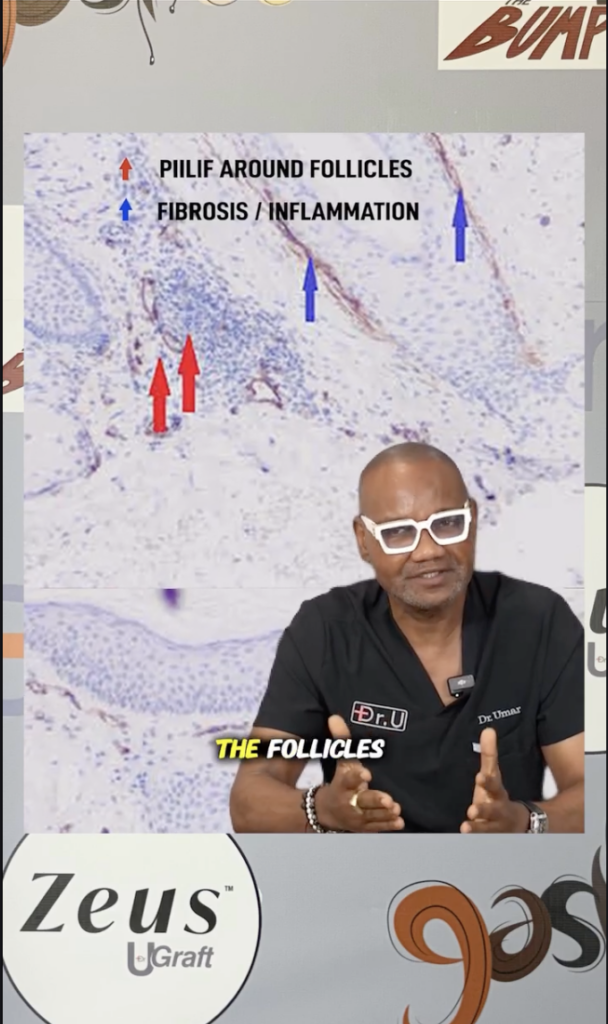
Retrograde Alopecia and a Hidden Inflammatory Pattern
The finding was especially relevant in severe pattern hair loss, including retrograde alopecia, according to the transcript. The approved social caption similarly notes that retrograde alopecia is often associated with androgenetic alopecia, or AGA, while research suggests that some patients may also have an overlapping inflammatory process called PIILIF.
This distinction matters because the short does not present retrograde alopecia as a diagnosis that should be managed automatically from its visible pattern alone. Instead, Dr. Umar points to what may be happening beneath the scalp as another part of the clinical picture.
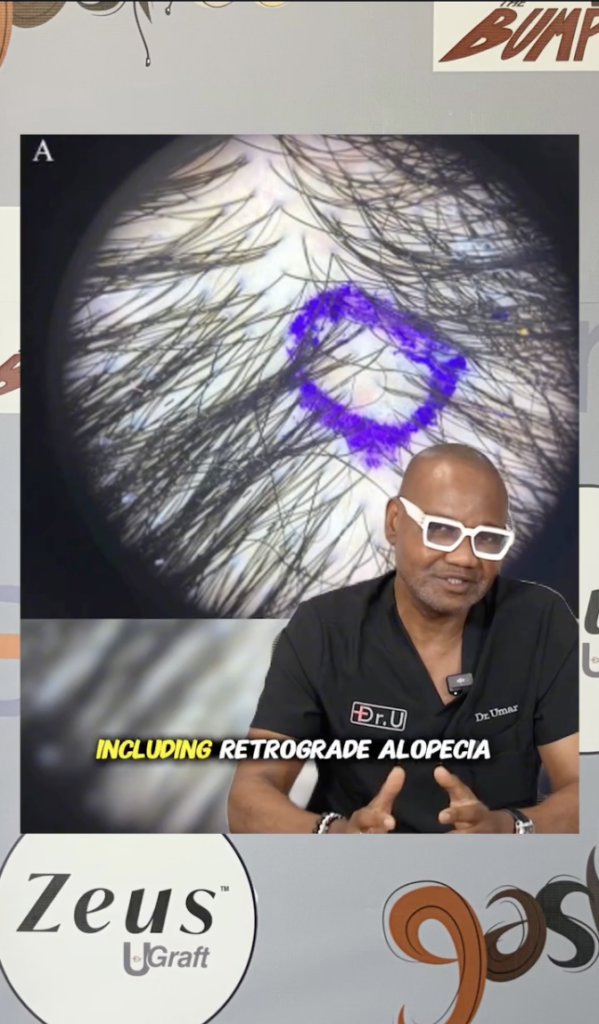
Why Some Cases May Resist Standard Treatment
Dr. Umar connects the research finding to a practical question: why do some cases resist standard treatment? His message is that retrograde alopecia “should not be treated on autopilot.” He advises looking deeper, checking for PIILIF, and considering both hormonal and inflammatory pathways when the individual evaluation supports that approach.
The short also emphasizes the need for individualized assessment. Hair loss is not always only about the pattern that can be seen, and understanding what is happening beneath the scalp may help guide hair loss diagnosis and treatment. The short does not claim that every person with retrograde alopecia has PIILIF, nor does it provide a universal treatment formula.
A Deeper Look at Scalp Biology
The takeaway is to avoid assuming that retrograde alopecia is simply advanced androgenetic alopecia in every case. When the clinical picture warrants it, Dr. Umar’s explanation supports a closer assessment of scalp biology and possible inflammatory involvement before deciding how to proceed.
Watch the Short Video
Take the Next Step
Learn more: Understanding Forms of Alopecia
Consultation: [[ADD CONSULTATION URL]]
Medical disclaimer: This content is for educational purposes only and is not medical advice. Individual results vary. Every patient is different, and hair loss evaluation and treatment should be individualized.
Further Reading
- https://dru.com/the-enigma-of-retrograde-alopecia-understanding-symptoms-and-unveiling-its-mysteries/
- Umar S, Tan BH, Shitabata PK. Perifollicular Inflammation and Fibrosis in Androgenetic Alopecia: Implications for Diagnosis and Treatment – A Comparative Histopathologic and Clinical Study with Normal-Appearing Scalp. Clin Cosmet Investig Dermatol. 2026;19:548520 https://doi.org/10.2147/CCID.S548520


