
John and Anwar came to Dr. Sanusi Umar with difficult scalp disease that had affected far more than appearance. One story begins with years of pain, isolation, and uncertainty. The other shows the later phase of healing from severe Folliculitis Decalvans, with visible changes that brought a different way of moving through the world.
When a Scalp Condition Starts Shrinking a Life
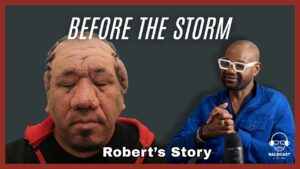
John’s story begins with the kind of burden that is easy to underestimate from the outside. In the video, he describes how the condition affected his motivation, mood, and willingness to be around other people. “It just hinders your life,” he says. “You just don’t want to do anything. It makes you depressed. It makes you have anxiety about going out.”
The approved caption adds that John had lived with painful scalp and neck disease for more than seven years. The visible changes became part of everyday decisions, including whether to look in a mirror, get a haircut, see friends, or spend time with family. Little by little, his world became smaller.
A loved one makes the stakes even more personal: “I want my cousin back. My son needs him. He’s an uncle.” That line shifts the story from a medical problem to a family problem. The condition was affecting John, but the withdrawal around it was also being felt by the people who cared about him.
Three Conditions, One Difficult Clinical Picture
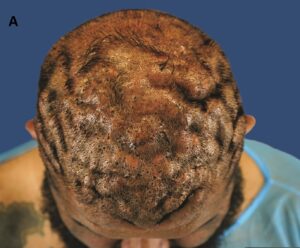
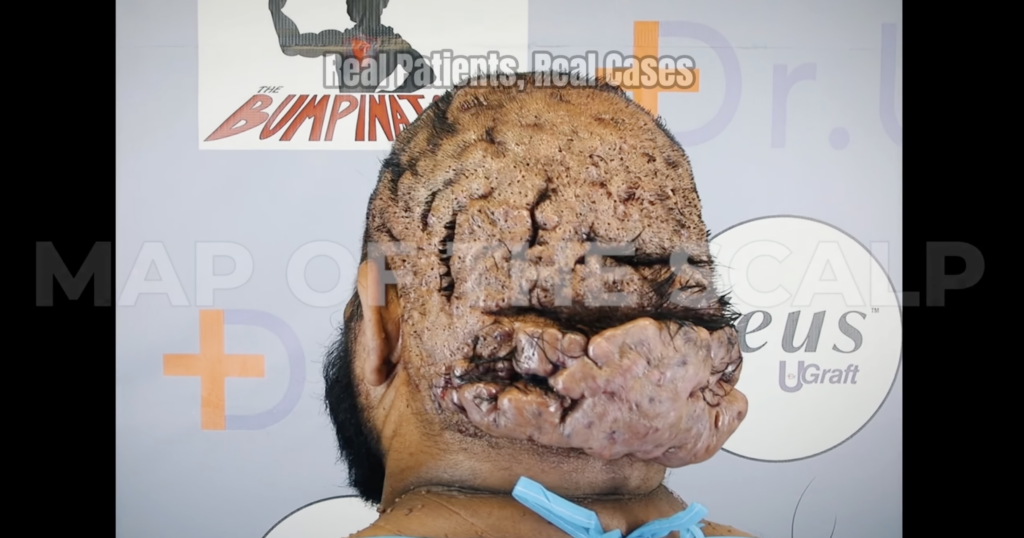
When John arrived for evaluation, Dr. Sanusi Umar identified a combination of scalp disorders rather than a single set of simple barber bumps. John had acne keloidalis nuchae (AKN) at the back of the head, cutis verticis gyrata (CVG), which produced deep folds and ridges across the scalp, and dissecting cellulitis, associated in the video with recurring boil-like areas and purulent discharge.
That combination mattered because it gave names to changes John had been living with for years. The caption describes the moment of recognition as important: once he understood that these were real medical conditions rather than a personal flaw, confusion and shame could begin to give way to understanding and a plan.
This is also why the phrase bumps on the back of the head can hide very different realities. Some people may use phrases such as huge razor bumps, barber bumps, keloid bumps, hard lumps on the neck, or bumps that won’t heal. In John’s case, the clinical picture included more than one condition, each contributing to what could be seen and felt across the scalp.
Dr. Umar’s role in the episode is to separate those problems clinically and explain what they mean. The video does not present every scalp lump as the same diagnosis. Instead, it shows why difficult cases require careful evaluation before treatment decisions are made.
Why Naming the Problem Can Change the Conversation
For John, diagnosis did not erase the years that came before it, but it changed the frame. The problem was no longer simply something visible that other people might stare at. It had names, patterns, and a medical context.
That distinction matters emotionally as much as clinically. The episode does not reduce John to the appearance of his scalp. His story includes the depression and anxiety he describes, the concern voiced by his family, and the optimism he still brings to the beginning of care. The caption credits his openness and strength while emphasizing that people living with long-term scalp disease may feel unseen even when the condition itself is highly visible.
The Bumpinator was created around cases like this: real patients, difficult conditions, and the practical work of understanding what is happening before trying to solve it. John’s portion of the episode represents the beginning of that process.
Anwar Shows a Different Point in the Same Kind of Story
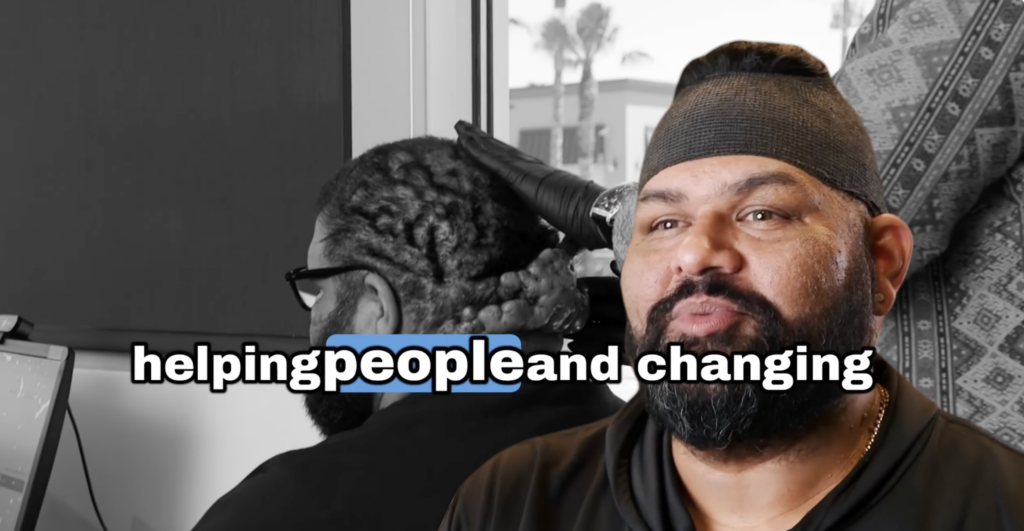
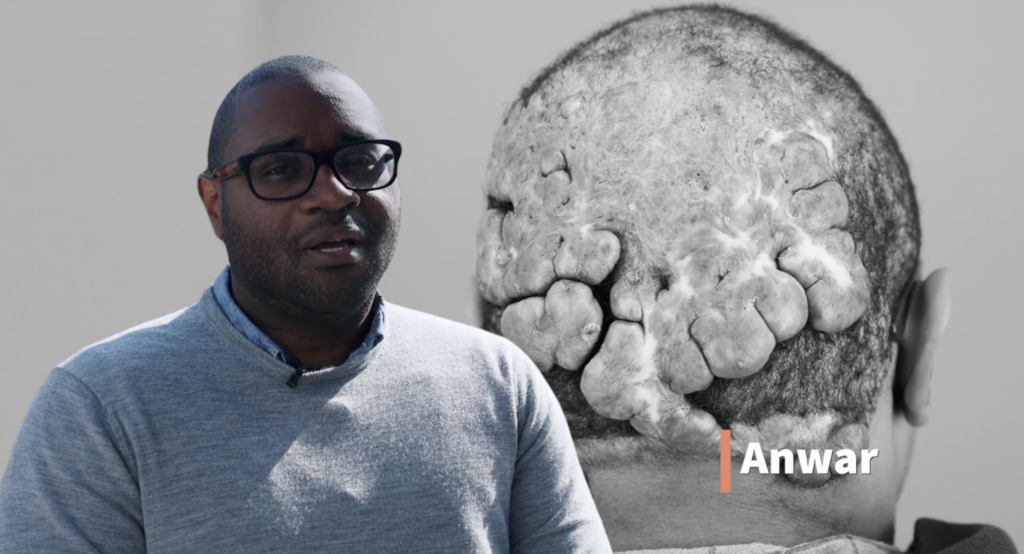
Anwar appears in the same episode at a very different point. His diagnosis is Folliculitis Decalvans, described in the video as a very severe case. He had lived for years with large raised bumps across the back of the head and neck, the kind of lesions that people may casually describe as giant razor bumps or keloid bumps.
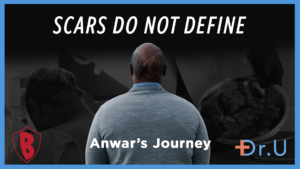
Where John is shown near the beginning of specialized care, Anwar is shown in the later phase of healing. The approved caption describes less pain, softer scars, a more natural hairline, and greater confidence in the way he moves through the world. Those observations belong to Anwar’s documented experience and should not be read as a guarantee for another patient.
The episode also shows the care process as something that unfolds over time. Dr. Umar discusses the wound-healing course and tells the patient that the first several days will be especially active. Later, the video presents an update on progress. The emphasis is not on a single dramatic instant, but on follow-up and the visible course of recovery.
From Large Scalp Bumps to the Later Phase of Healing
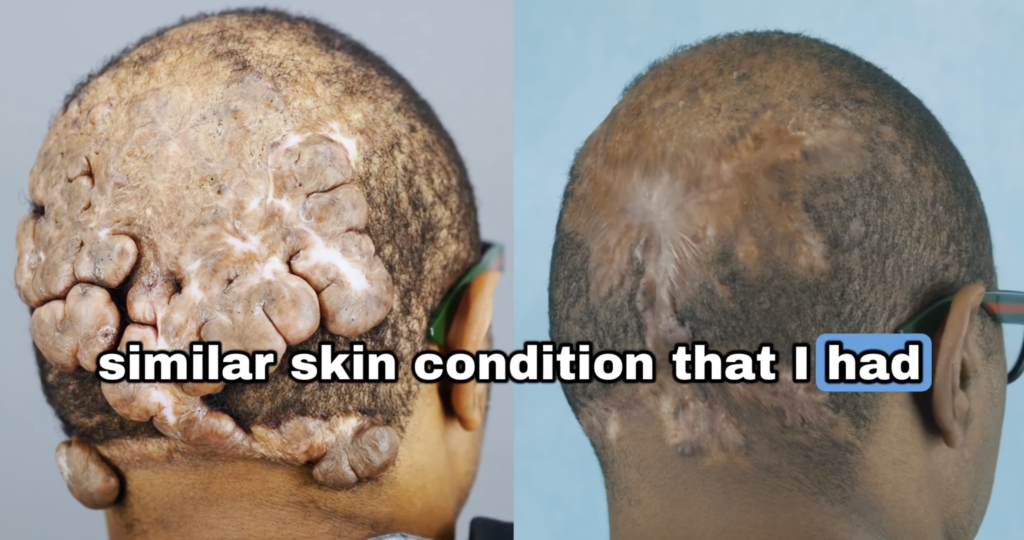
The contrast in Anwar’s clinical images is central to the episode because it gives viewers a visual reference for what severe Folliculitis Decalvans can look like and what his later healing phase looked like. The earlier clinical view shows multiple large raised masses across the back of the scalp and neck. In the later view, the raised masses are no longer present in the same way, and areas of flatter scarring and hair coverage are visible.
The video and caption are careful not to turn that comparison into a universal promise. Dr. Umar discusses treatment approaches that may help selected patients with difficult scalp conditions. The important word is selected. John and Anwar each represent an individual medical history, not a template that can be applied to everyone who has bumps that won’t heal.
For viewers searching because they have painful boils on the head, thick scars, or persistent bumps on the back of the head, the episode offers a more useful starting point than assuming every lesion is ordinary razor irritation. It shows that visually similar complaints can involve complex and overlapping scalp disease.
The Person Behind the Clinical Photograph
Graphic clinical photographs can easily pull attention toward the condition and away from the person. This episode deliberately moves in the opposite direction. John’s family talks about wanting him back in their lives. Anwar participates in showing a later stage of his recovery so that other people with comparable concerns can recognize that they are not the only ones searching for answers.
That is the human link between their stories. One patient is learning what his conditions are and beginning to see a path forward. The other allows viewers to see what a later phase of healing looked like in his case. Both stories ask the audience to look beyond the surface and understand what chronic scalp disease can do to confidence, social life, and everyday freedom.
Why John and Anwar’s Stories Belong Together
John and Anwar do not have identical medical histories, and the episode does not treat them as if they do. Their stories belong together because they show two points along the broader experience of living with difficult scalp disease.
John represents the moment when a complicated condition is finally being named. His account gives language to the emotional burden: depression, anxiety, withdrawal, and the effect on family relationships. Anwar represents a later stage after treatment for severe Folliculitis Decalvans, when the episode can document healing and the changes he reports in comfort and confidence.
For Dr. Umar, the clinical responsibility is different at each point but connected by the same principle. The first task is to understand the problem accurately. The next is to build and guide an appropriate treatment plan, then follow the patient through healing. The patients, in turn, contribute the willingness to seek care, tolerate a difficult process, return for follow-up, and allow their experiences to be shared.
That partnership is the point of The Bumpinator. It is not a collection of unusual photographs. It is a record of people whose skin and scalp conditions have affected their lives, and of the clinical work required to understand and address those conditions without losing sight of the person.
Watch the Full Video
https://youtu.be/zTSVsa3B_24?si=yVSoSAPcW3afDxiz
Watch John at the beginning of his healing process and Anwar in the later phase of his recovery in this full episode of The Bumpinator.
Take the Next Step
Free ConsultationIf you are dealing with persistent scalp bumps, recurring boil-like areas, thick scars, or bumps that won’t heal, a qualified medical evaluation can help determine what condition is actually present and what options may be appropriate for your individual case.
Medical Disclaimer
This article presents individual patient experiences for educational purposes only. It does not provide a diagnosis, guarantee a result, or replace evaluation and treatment by a qualified healthcare professional. Individual conditions, treatment plans, healing courses, and outcomes vary.
Further Reading
- Umar, S., & Sila, C. R. (2021). Acne keloidalis nuchae: A role for low-dose radiotherapy. JAAD Case Reports, 13, 90–93. https://doi.org/10.1016/j.jdcr.2021.05.008
- https://dru.com/bumpinator-docuseries-anwar-folliculitis-decalvans/