


After Adrian’s episode opened a wider discussion, Salma in Morocco asked Dr. Sanusi Umar how acne keloidalis nuchae differs from folliculitis, keloids, and ingrown hairs. It is an important distinction for people trying to understand hairline bumps or bumps on the back of the head, because conditions that may look similar can represent different underlying problems.
Folliculitis Describes Inflammation of the Hair Follicles
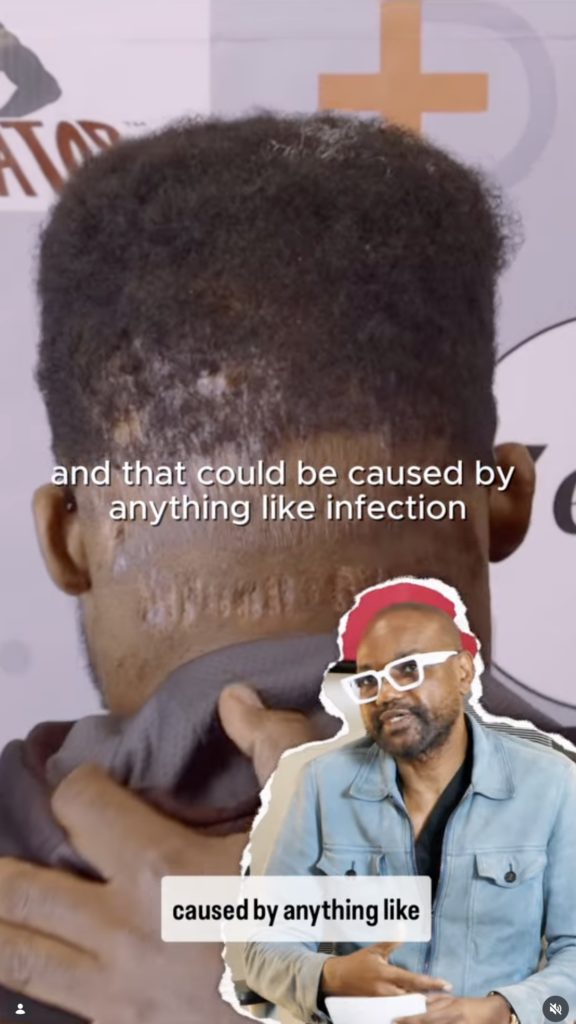
Dr. Umar begins with the broadest term in the question. “Folliculitis just means inflammation of the hair follicles,” he explains. In the video, he adds that this inflammation can have causes such as infection. The key point is that folliculitis describes inflammation involving the follicles rather than identifying every scalp bump as the same disease.
That distinction matters when someone sees irritation, bumps, or changes around the hair-bearing scalp. The appearance alone may not explain what process is taking place underneath, which is why Dr. Umar separates the terms instead of treating them as interchangeable.
AKN Is a Scarring Hair Condition
When Dr. Umar turns to acne keloidalis nuchae, or AKN, he describes it as a scarring alopecia condition and emphasizes, “Actually, it’s a hair condition.” The matching caption similarly frames AKN as a scarring inflammatory condition of the hair follicle and stresses that it should not simply be equated with an infection, a typical keloid, or an ingrown hair.
This is why the name can be misleading for people encountering it for the first time. AKN and ordinary keloids are not presented in the chapter as the same diagnosis, even though some patients may have lesions that look alike.
Why AKN and Keloids Can Be Confused
Dr. Umar describes keloids separately, calling them a fundamental genetic defect. He also notes that both conditions have a tendency to recur and that, in some patients, they can look alike. That visible similarity helps explain why a person may struggle to tell the difference based only on appearance.
For Salma’s question, the takeaway is not to rely on a label based solely on what a bump resembles. Dr. Umar’s explanation centers on understanding the nature of the condition itself. The Baldcast Q&A keeps the answer concise, but it gives viewers a clearer framework for why folliculitis, acne keloidalis nuchae, and keloids should not automatically be treated as the same thing.
Watch the Chapter
Take the Next Step
Watch this chapter on Instagram or TikTok.
For a further explanation of acne keloidalis nuchae, watch Dr. Umar’s additional Instagram video.
Free Consultationhttps://dru.com/akn-treatment/
Medical Disclaimer
This article is for educational purposes only and does not provide a diagnosis or replace evaluation and treatment by a qualified healthcare professional. Individual scalp and hair conditions can differ in appearance, cause, course, and appropriate treatment.
Further Reading
- https://dru.com/keloid-removal/
- Umar, Sanusi et al. “A Retrospective Cohort Study and Clinical Classification System of Acne Keloidalis Nuchae.” The Journal of clinical and aesthetic dermatology vol. 14,4 (2021): E61-E67. https://www.ncbi.nlm.nih.gov/pmc/articles/PMC8142833/


