


Dr. Sanusi Umar explains why inflammation around hair follicles may be an important consideration in some cases of pattern hair loss, including when treatment or transplantation has not produced the expected response.
Why does some hair loss resist medical treatment and even a hair transplant? That is the question Dr. Sanusi Umar raises in this short video about androgenetic alopecia, also called AGA or pattern hair loss. His focus is a follicular inflammatory pattern called AGA-PIILIF.
When Pattern Hair Loss Includes Inflammation
Pattern hair loss does not necessarily tell the entire story of what is happening around a follicle. As Dr. Umar explains, inflammation may affect the upper portion of the hair follicle, the small structure from which hair grows. Persistent inflammation may lead to fibrosis, meaning scar tissue.
In the setting of androgenetic alopecia, Dr. Umar refers to this combination as AGA-PIILIF. His explanation does not suggest that every person with pattern hair loss has this finding. Instead, he identifies inflammation as a possible contributing factor in some patients whose hair loss has resisted treatment.
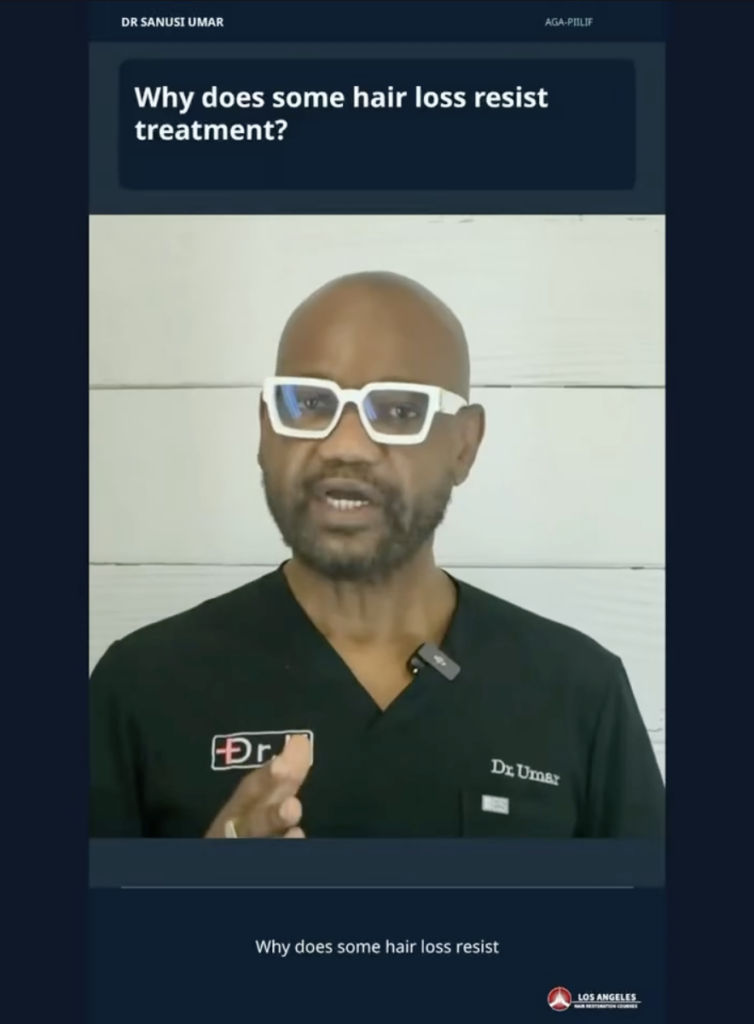
What the Referral-Center Study Found
Dr. Umar cites a study from his specialist referral center that included 129 patients with androgenetic alopecia. According to the video, more than 80% of those patients showed the inflammatory pattern he describes. This is a finding from that particular referral-center population, not a claim about all people with pattern hair loss.
The accompanying illustration shows inflammation surrounding a hair follicle. It helps make the central point of the video visible: a process affecting the follicle may be relevant even when the surface appearance of the scalp does not explain the full clinical picture.

Why Recognition Matters for Hair Transplant Planning
The practical message is not that inflammation explains every disappointing result. Rather, recognizing AGA-PIILIF can change what needs to be considered. Dr. Umar says it means addressing both pattern hair loss and inflammation, particularly when planning a hair transplant.
The video presents a reason to evaluate the scalp carefully instead of treating pattern hair loss as a single uniform process. The accompanying caption also points to trichoscopy and biopsy sampling as topics explored in the longer explanation, but this short excerpt does not establish a specific diagnostic protocol or treatment regimen.
For patients discussing persistent hair loss or hair transplantation, the takeaway is a focused question for their clinician: could follicular inflammation be relevant to the treatment plan? The answer requires an individualized clinical assessment.
Watch the Short Video
Take the Next Step
Discuss persistent or unexpected hair loss with a qualified clinician who can evaluate your individual circumstances.
Free ConsultationMedical Disclaimer
This article is for educational purposes only and does not provide a diagnosis or individualized medical advice. Findings from a specialist referral-center study may not apply to every patient. Consult a qualified medical professional about diagnosis and treatment.
Further Reading
- https://dru.com/preparing-patients-for-hair-transplant-lpp-patients-or-other-scarring-alopecia-patients-for-hair-transplant-surgery-ffa-ccca/
- Eremia Sorin, Umar Sanusi H, Li Cindy Y: Prevention of temporal alopecia following rhytidectomy: The prophylactic use of minoxidil. A study of 60 patients. Dermatologic Surgery 2002;28:66-74
https://pubmed.ncbi.nlm.nih.gov/11991275/


