


Eighteen months can make a striking visual difference in a single patient story. In this Bumpinator short, Festus is shown across an 18-month span after surgical keloid removal for severe keloids and multiple recurrent keloids, with the focus kept on documented change rather than spectacle.
A Difficult Recurrent Keloid Case
Festus had a severe, recurrent keloid case. The supplied before image shows large raised growths around his ears, jawline, and neck. The video then moves to an 18-month comparison after surgical keloid removal, giving viewers a direct look at how his appearance changed over time.
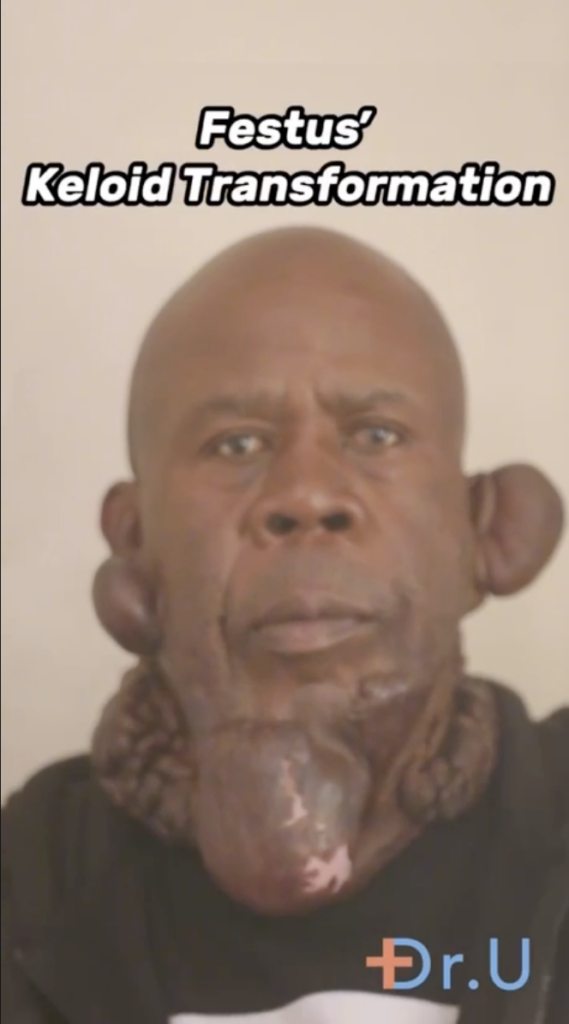
Documenting Change Over 18 Months
The later image shows Festus smiling 18 months after the surgical removal described in the caption. The purpose of the comparison is not to suggest that every patient will have the same result. Instead, it records visible change over time in one patient whose history included multiple recurrent keloids.

Why Individualized Evaluation Matters
The chapter emphasizes that when a bump keeps returning or growing, the history and diagnosis matter. Recurrent keloids are not presented as a one-size-fits-all problem. Festus’s experience is one case, and the supplied caption explicitly notes that results can vary.
The video closes with a simple message: “Impossible is I’m Possible.” In the context of this short, the phrase follows the 18-month comparison and leaves the focus on Festus’s documented experience and the importance of careful, individualized evaluation.
Watch the Chapter
Instagram Reel: https://www.instagram.com/reel/Dc6ZKXiByAd/?stkn=YzAyMDM1MGJkZA==
Take the Next Step
Free Consultationhttps://dru.com/akn-treatment/
Medical Disclaimer
This is one patient’s experience. Individual results vary. This content is for educational purposes only and is not medical advice.
Further Reading
- https://dru.com/festus-recurrent-keloids-final-chapter/
- Umar S, Khanna R. Papular acne keloidalis nuchae treatment success using follicular unit excision. JAAD Case Rep. 2023 Jul 25;39:96-100. doi: 10.1016/j.jdcr.2023.07.013. PMID: 37621307; PMCID: PMC10445098.
https://pmc.ncbi.nlm.nih.gov/articles/PMC10904000/


